


- Marques
- TRESTON Arbeitsplatzsysteme
- All catalogs from TRESTON Workplace systems
- Treston main catalog
- Treston main catalog Page 106
Treston main catalog Page 106
Offre client commercial**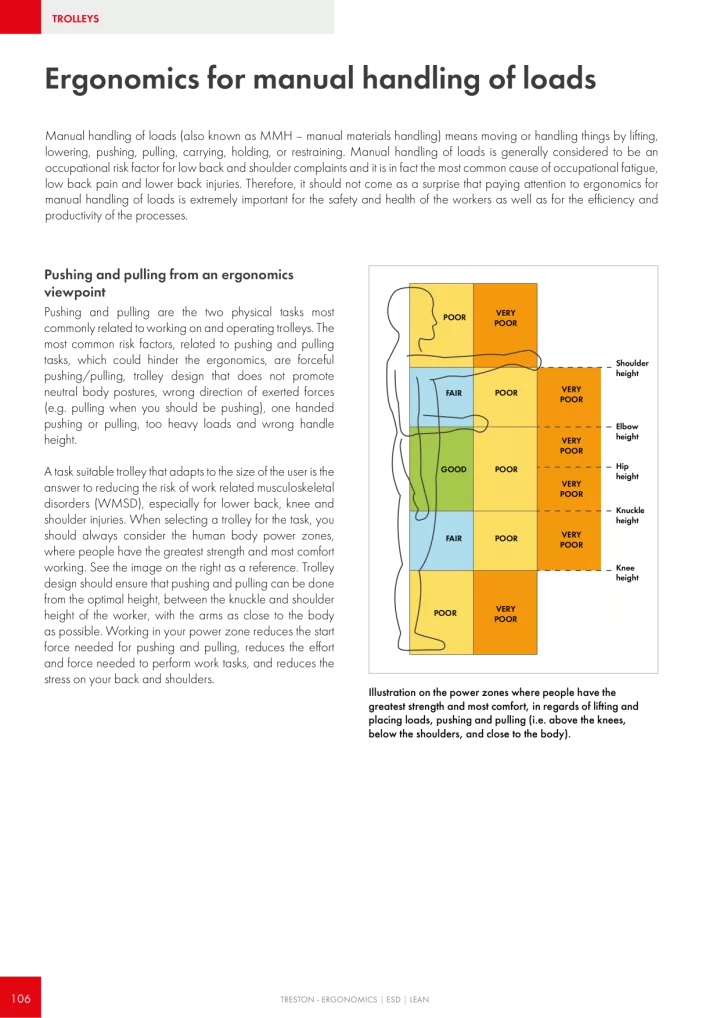
Afficher les produits
keyboard_arrow_up
keyboard_arrow_down
/ 216
Produits de la page du catalogue
0



ARE
85,00 €
hors Expédition
(42,50 € / Pièce)
Voir tous les produits TRESTON Arbeitsplatzsysteme
TROLLEYS Ergonomics for manual handling of loads Manual handling of loads (also known as MMH – manual materials handling) means moving or handling things by lifting, lowering, pushing, pulling, carrying, holding, or restraining. Manual handling of loads is generally considered to be an occupational risk factor for low back and shoulder complaints and it is in fact the most common cause of occupational fatigue, low back pain and lower back injuries. Therefore, it should not come as a surprise that paying attention to ergonomics for manual handling of loads is extremely important for the safety and health of the workers as well as for the efficiency and productivity of the processes. Pushing and pulling from an ergonomics viewpoint Pushing and pulling are the two physical tasks most commonly related to working on and operating trolleys. The most common risk factors, related to pushing and pulling tasks, which could hinder the ergonomics, are forceful pushing/pulling, trolley design that does not promote neutral body postures, wrong direction of exerted forces (e.g. pulling when you should be pushing), one handed pushing or pulling, too heavy loads and wrong handle height. POOR VERY POOR Shoulder height FAIR POOR VERY POOR VERY POOR GOOD A task suitable trolley that adapts to the size of the user is the answer to reducing the risk of work related musculoskeletal disorders (WMSD), especially for lower back, knee and shoulder injuries. When selecting a trolley for the task, you should always consider the human body power zones, where people have the greatest strength and most comfort working. See the image on the right as a reference. Trolley design should ensure that pushing and pulling can be done from the optimal height, between the knuckle and shoulder height of the worker, with the arms as close to the body as possible. Working in your power zone reduces the start force needed for pushing and pulling, reduces the effort and force needed to perform work tasks, and reduces the stress on your back and shoulders. POOR VERY POOR Elbow height Hip height Knuckle height FAIR POOR VERY POOR Knee height POOR VERY POOR Illustration on the power zones where people have the greatest strength and most comfort, in regards of lifting and placing loads, pushing and pulling (i.e. above the knees, below the shoulders, and close to the body). 106 TRESTON - ERGONOMICS | ESD | LEAN
216 Pages | Valable jusqu’au 12/2024 | Page précédente | Page suivante
PDF Download (102MB)
Enregistrer la page au format PDF
Demande de devis
(sans engagement)
Choisissez votre langue


Probleme juridique
L’offre s’adresse exclusivement aux clients professionnels, entreprises, institutions publiques, commerçants et indépendants. Tous les prix dans les catalogues s’entendent hors TVA, frais de port et suppléments le cas échéant.
Le fabricant est exclusivement responsable du contenu, des prix et des détails des articles et des offres présentés dans les catalogues. Sous réserve de modifications techniques et optiques du fabricant et sous réserve d’erreurs.
Formulaire de demande de produits spéciaux


Le service d’approvisionnement ToolTeam®
Vous recherchez des produits qui figurent dans le catalogue mais ne peuvent pas être achetés directement en ligne ?Notre service d’approvisionnement se fera un plaisir de vous faire une offre individuelle et sans engagement.
Veuillez remplir tous les champs obligatoires (soulignés en rouge)
keyboard_arrow_down
- Uni-Elektra GmbH
- RHODIUS Abrasives GmbH
- Proxxon GmbH
- Robert Bosch GmbH - Power Tools
- Makita-Werkzeug GmbH
- BESSEY Tool GmbH & Co.KG
- KUKKO - Kleinbongartz & Kaiser OHG
- Zweibrüder Optoelectronics GmbH & Co.KG
- KS TOOLS Werkzeuge-Maschinen GmbH
- BAHCO - SNA Germany GmbH
- 3M Deutschland GmbH
- Chicago Pneumatic
- PFERD-Werkzeuge - August Rüggeberg GmbH & Co. KG
- HAZET-Werk Hermann Zerver GmbH & Co. KG
- Arnz FLOTT GmbH Werkzeugmaschinen
- BMI Bayerische Massindustrie Arno Keller GmbH
- LOKOMA Lorenz Kollmann GmbH
- FEIN - C. & E. Fein GmbH
- RUKO GmbH Präzisionswerkzeuge
- Genius Tools
- Caramba Chemie GmbH & Co. KG
- August Löher GmbH
- Knipex-Werk C. Gustav Putsch KG
- WD-40 Company Verkaufsbüro Deutschland
- Flowdrill Fließformwerkzeuge GmbH
- Brockhaus HEUER GmbH
- TEST
- SONAX GMBH
- Rothenberger Werkzeuge GmbH
- STAHLWILLE Eduard Wille GmbH
- PICARD - Joh. Herm. Picard GmbH & Co.KG
- KEIL Werkzeugfabrik
- Hepco & Becker GmbH
- Thermdrill - ONTOOL GmbH
- MATADOR GmbH & Co. KG
- NWS Germany Produktion W. Nöthen e. K.
- Wiha Werkzeuge GmbH
- STABILA Messgeräte Gustav Ullrich GmbH
- GEDORE Werkzeugfabrik GmbH & Co. KG
- HEDI GmbH Elektro- Und Gerätebau
- wolfcraft GmbH
- Wera Werkzeuge GmbH
- Optimum Maschinen Germany GmbH
- Vogel Germany
- Orbis Will GmbH + Co. KG
- MARTOR KG
- ALARM Werkzeuge GmbH
- KRAFTWERK Deutschland GmbH
- Leica
- Laserliner - UMAREX GmbH & Co. KG - Bereich Laserliner -
- BAER Vertriebs GmbH
- RENNSTEIG Werkzeuge GmbH
- Huber Maschinenbau Inh. Reiner Huber
- VIGOR GmbH
- VBW Werkzeugfabrik GmbH
- Landefeld
- Factor
- PTG Präzisions-Technik Handelsgesellschaft mbH
- EXACT GmbH & Co. KG Präzisionswerkzeuge
- WESPA Metallsägenfabrik
- PUK
- STANLEY - StanleyBlack&Decker Deutschland GmbH
- Gesipa-Blindniettechnik GmbH
- Diewe GmbH Diamantwerkzeuge
- WAG
- Mueller
- Bibielle S.p.A.
- Cedima GmbH
- Klingspor AG
- ULMIA GmbH
- Lessmann GmbH
- Rahsol
- PROJAHN Präzisionswerkzeuge GmbH
- HaFu Werkzeugfabrik H.J. Fuhrmann GmbH
- Erdi
- Georg Steinmetz GmbH
- Jokari
- Cimco
- BECK - August Beck GmbH & CO. KG
- Peddinghaus Handwerkzeuge Vertriebs GmbH
- K. Löffert GmbH
- HA-SO - E. Haarhaus Sohn GmbH & Co. KG
- Dako Werk Dowidat GmbH & Co. KG
- Härke GmbH & Co. KG
- Glaeser
- Heinz Schuller KG
- fischer Deutschland Vertriebs GmbH
- P. Hermann Jung KG
- Hansa Armaturen GmbH
- Rodax
- BWG Bauteam Profi Produkte Vertriebs & Logistik GmbH
- AIinside.cloud
- Kronen-Hansa-Werk GmbH & Co.
- Happe
- Camping Gaz Deutschland GmbH
- Lorch
- WKS Schweisstechnik GmbH
- Kayser-Werk GmbH
- Feldtmann - Helmut Feldtmann GmbH
- Ibeda
- Hilco
- Schweisstechnik Oerlikon GmbH
- Thyssen Mannesmann
- EDESSÖ Tools and More GmbH & Co.KG.
- Jack
- Sandvik
- Tajima-Tools Heinz Schmidt
- KIRSCHEN Werkzeuge - Wilh. Schmitt & Comp. GmbH & Co.KG
- FAMAG-Werkzeugfabrik GmbH & Co. KG
- Alwema
- Cyrus
- Klemmsia - Ernst Dünnemann GmbH & Co KG
- GROSS STABIL TOOL GmbH
- 3 Holz GmbH & Co. KG
- Heyco-Werk Heynen GmbH & Co. KG
- Sortimo International GmbH
- PARAT GmbH + Co. KG
- as - Schwabe GmbH
- brennenstuhl - Hugo Brennenstuhl GmbH & Co.KG
- PRESSOL - Pressol Schmiergeräte GmbH
- SCHIESS Werkzeugmaschinenfabrik GmbH
- Prebena Wilfried Bornemann GmbH & Co. KG
- Novus
- ITW Befestigungssysteme GmbH
- STEINEL Vertrieb GmbH
- Johann Froescheis Lyra-Bleistift-Fabrik GmbH &
- Milwaukee
- DREMEL Europe
- Metabo - Metabowerke GmbH
- Holzstar
- METALLKRAFT - Stürmer Maschinen GmbH
- Holzkraft
- DEWALT - StanleyBlack&Decker Deutschland GmbH
- FESTOOL - Festool Group GmbH & Co.KG
- Protool - Festool Group GmbH & Co.KG
- Stihl Vertriebszentrale AG & Co.
- KÄRCHER - Alfred Kärcher Vertriebs-GmbH
- Rent a Tool
- Schneider Druckluft GmbH
- AIRCRAFT - Stürmer Maschinen GmbH
- Hans Wilms
- PRAMAC GmbH
- Eibenstock - Elektrowerkzeuge GmbH Eibenstock
- Mafell AG
- Hikoki Power Tools Deutschland GmbH
- AEG
- RYOBI - TTI-EMA Techtronic Industries Central Europe GmbH
- Hawera
- ALPEN-MAYKESTAG GmbH
- Wap
- Brinkmann + Wecker GmbH
- IDEALSPATEN-Bredt GmbH und Co. KG
- ALFRA GmbH - Blechlocher
- Ambratec GmbH
- Rodcraft
- AMF - ANDREAS MAIER GmbH & Co. KG
- Sonic Equipment GmbH
- Flott XYZ Machine Tools
- NORDWEST Handel AG
- A. Binzel Schweisstechnik GmbH & Co.KG
- Artur Düllmann
- A. Schweizer GmbH
- ABEBA Spezialschuh-Ausstatter GmbH
- ABUS - August Bremicker Söhne KG
- Adler Werkzeug GmbH & Co.KG
- adlus GmbH
- Nissen - Adolf Nissen Elektrobau GmbH & Co. KG
- Alba-Krapf AG
- Albrecht Präzision GmbH & Co. KG
- CLOU - Alfred Clouth Lackfabrik GmbH & Co.KG
- ALMI Machinefabriek BV
- ALTRAD LESCHA GmbH
- ALUTEC München GmbH
- Anrotec e. K.
- Ansell Healthcare Europe N.V Riverside Business Park
- ANSMANN AG
- Potthoff - Arnold Potthoff GmbH & Co. KG
- ARTILUX SWISS SAFETY
- ASATEX AG
- ASSA ABLOY Sicherheitstechnik GmbH
- ASUP
- ASW Andreas Heuel GmbH
- Athmer oHG
- ATIKA GmbH
- August Vormann GmbH & Co. KG
- Augusta-Heckenrose Werkzeugfabriken GmbH & Co.KG
- BARKE-Maschinenmesser GmbH
- Martin Becker Verpackungen GmbH
- Beko GmbH
- BENNING Elektrotechnik und Elektronic GmbH & Co.KG
- Berg & Schmid GmbH
- BERG TECTOOL GmbH
- Bernhard Hohage GmbH & Co.KG
- Bertram & Graf GmbH
- Bever & Klophaus GmbH
- Beyer + Müller GmbH & Co
- Bimos - Interstuhl Büromöbel GmbH & Co. KG
- BKS GmbH
- BMB Beschläge GmbH
- Bohle AG
- Bott GmbH & Co. KG
- Braun GmbH
- Brunox Korrosionsschutz GmbH
- BS Rollen GmbH
- BURG-WÄCHTER KG
- C. Jul. Herbertz GmbH
- CAMAR S.P.A.
- Carl Baier GmbH & Co.
- Carl Capito GmbH Geschäftsbereich Transportgeräte
- Carl Fuhr GmbH & Co.KG
- Carl Turck GmbH & Co. KG
- Cemo GmbH
- Chem. Werke Kluthe GmbH
- COBA Europe GmbH
- Collomix GmbH
- Columbus McKinnon Industrial Products GmbH
- ContiTech Schlauch GmbH
- Coroplast Fritz Müller GmbH & Co. KG
- CRC Industrie Deutschland GmbH
- Den Braven - DEBRATEC GMBH
- Diefra Light GmbH
- Dinzl-Ordnungstechnik GmbH
- Diversey Deutschland GmbH & Co. OHG
- ELEMENT SYSTEM - DIY Element System GmbH
- Dolezych GmbH&Co.KG Westdeutscher Drahtseilverkauf
- OGRO Beschlagtechnik GmbH
- dormakaba Deutschland GmbH
- Dr. Gold & Co. KG
- Drahtzieherei Wiesenburg GmbH
- Dransfeld GmbH & Co. KG
- DRATEC Drahttechnik GmbH
- DRONCO GmbH
- DuPont de Nemours S.a.r.l. GB Protection Technologies
- DURABLE Hunke & Jochheim GmbH & Co. KG
- Durlach GmbH Industrieausrüstung
- DWT GmbH
- E. C. Emmerich GmbH + Co. KG
- E. Schäfer Vertrieb Inh. Wolfgang Holzwarth
- EBARA Pumps Europe S.p.A. Niederlassung
- econ-Systems GmbH
- EKASTU Safety GmbH
- Elbe-Werkstätten GmbH
- Elco GmbH
- STARMIX - ELECTROSTAR GmbH
- ELTEN GmbH
- Emil Deiss KG (GmbH + Co.)
- Endress Elektrogerätebau GmbH
- Ennepetaler Sensenwerk KG
- erfi GmbH Maschinenbau und Elektrotechnik
- Erich Dieckmann GmbH Beschlagfabrik
- Gausmann - Ernst B. Gausmann GmbH
- Ernst Hausammann & Co.AG
- ERSA GmbH
- Erso Indulux-Wäller GmbH & Co. KG
- HALDER Handwerkzeuge - Erwin Halder KG
- OEL-KLEEN - ESV GmbH
- Eureka Tecwear GmbH & Co. KG
- EUROLATON-DEUTSCHLAND GmbH
- ewo Armaturen-Autogengeräte Hermann Holzapfel GmbH & Co.KG
- Tuetemann - F. Tütemann GmbH & Co. KG
- BALLISTOL - F.W. Klever GmbH
- FELCO DEUTSCHLAND GmbH
- Felder GmbH
- fetra Fechtel Transportgeräte GmbH
- FHB original GmbH & Co.KG
- Fiskars Germany GmbH
- FLORA Wilh. Förster GmbH & Co. KG
- Format Tresorbau GmbH & Co. KG
- FORMENTI & GIOVENZANA S.p.A. Divisione GIEFFE
- Franz Haimer GmbH
- Franz Schneider Brakel GmbH + Co KG
- FREUND VICTORIA Gartengeräte GmbH
- DICK Werkzeuge - Friedr. Dick GmbH & Co. KG
- Friedrich Küpper Werkzeug- u. Maschinenbau GmbH
- Friedrich Müller GmbH Schleifmittelwerk
- Fridavo - Fritz Dannert GmbH & Co. KG
- Fritz-Heinrich Bruer e.K. Holzwarenfabrik
- GANN Mess- und Regeltechnik GmbH
- GasIQ AB
- GasTec Gasgerätetechnik GmbH
- GCE GmbH & Kayser Werk GmbH
- LÖWE - Gebr. Schröder GmbH
- Gebrüder Schulte GmbH & Co. KG
- Gebr. Werth GmbH & Co.KG
- GEBRA GmbH & Co. Sicherheitsprodukte KG
- Geze GmbH
- GFS Gesellschaft für Sicherheitstechnik mbH
- Gloria GmbH
- Gruber Systeme Horst Gruber
- Grüner & Co. GmbH
- Günther Pulverich GmbH
- GÜNZBURGER STEIGTECHNIK GMBH
- GAH ALBERTS - Gustav Alberts GmbH & Co. KG
- daiber - Gustav Daiber GmbH
- Gutkes GmbH
- GYS GmbH
- H. R. Rathgeber GmbH & Co. KG
- Hailo - Rudolf Loh GmbH & Co. KG
- HANSI-Siebert GmbH & Co. KG
- HAROMAC Werkzeugfabrik GmbH & Co.KG
- Harris Calorific GmbH
- Hedue GmbH
- HBS - Heinr. Betz Söhne GmbH & Co. KG
- Heinrich Strenger GmbH
- Helios-Preisser - Mahr GmbH
- Helit innovative Büroprodukte GmbH
- Heller Tools GmbH
- Helly Hansen Deutschland GmbH
- Henkel AG & Co.KGaA Abt.A.A.G KAM HW
- Henkel KGaA Standort München
- Hermann Fliess & Co. GmbH
- Hermann Schwerter
- Hermann Wolz GmbH
- Hermes Schleifmittel GmbH & Co.KG
- Hettich Furn Tech GmbH&Co.KG Division Professional
- HEWI Heinrich Wilke GmbH
- HITEC Meßtechnik GmbH
- Hoju-Beschlag GmbH
- Holt-Waterloo International
- Holtz Office Support
- Honeywell Safety Products Deutschland GmbH & Co. KG
- Hoppe AG
- horizont group gmbh - Division klemmfix -
- Tecalemit GmbH & Co. KG
- HSM GmbH + Co. KG
- Hüdig & Rocholz GmbH & Co. KG
- Hünersdorff GmbH
- Hylomar GmbH
- IKS Klebebandsysteme GmbH & Co.KG
- Ing. Alfred Häner GmbH
- Irion Vertriebs GmbH
- Isaberg Rapid AB c/o Esselte Leitz GmbH & Co KG
- ISM Heinrich Krämer GmbH & Co. KG
- itp-international tooling partner GmbH
- ITW Spraytech Germany ITW LLC & Co.KG
- J. D. Geck GmbH
- Jäger Direkt GmbH & co. KG
- JAS - Jan Segenwitz GmbH
- JATEC GmbH
- Jepson Power GmbH
- Jos. Haunstetter Sägenfabrik KG
- Jutec Hitzeschutz & Isolationstechnik GmbH
- Käfer Messuhrenfabrik GmbH & Co. KG
- Kaim-Industrieprodukte Groß- und Einzelhandel
- Kappes-Systeme GmbH
- Karasto Armaturenfabrik Öhler GmbH
- Karl Hagenböcker
- Katimex Cielker GmbH
- KCL GmbH Industriepark Rhön
- KELMAPLAST G. Kellermann GmbH
- Kemper GmbH
- Kiesel GmbH
- Kimberly-Clark GmbH
- Kind Arbeitssicherheit GmbH
- Kip GmbH
- Kneetek Klaus Bachmann
- Koll Packband GmbH & Co.KG
- Krumpholz Werkzeuge
- FRISTADS KANSAS Deutschland GmbH
- L & M Laser Und Messtechnik GmbH
- Lamello GmbH Verbindungstechnik
- Leipold + Döhle GmbH
- Leitz GmbH & Co. KG
- LEMAITRE Deutschland GmbH
- Leonhardt Fohrmann GmbH Stielfabrik
- Lincoln Electric Deutschland NL
- LiteXpress GmbH
- Litty Handelsges.mbH
- Lockweiler Plastic Werke GmbH
- Lorenz Zangen GmbH & Co.KG
- Lotz Lagertechnik GmbH
- L-Shop-Team GmbH
- Lukas Meindl GmbH & Co. KG
- WESCO - M. Westermann & Co. GmbH
- MAS Absturzsicherungen GmbH
- Marston-Domsel GmbH
- Mascot International GmbH
- Mato GmbH & Co.KG
- Mauser Einrichtungssysteme GmbH & Co.KG
- MAXION Jänsch &. Ortlepp GmbH
- Merkle Schweißanlagen- Technik GmbH
- Mesto Spritzenfabrik Ernst Stockburger GmbH
- Metallwerke Renner GmbH
- META-Regalbau GmbH & Co. KG
- Meyer-Chemie GmbH & Co. KG
- MOLDEX - Moldex-Metric AG & Co.KG
- Möller-Industrietechnik GmbH
- MOTIP DUPLI GmbH
- Mühlmeier GmbH & Co. KG
- müba - Müller & Baum GmbH & Co. KG
- Nedo GmbH & Co.KG
- DENI - Niederhoff & Dellenbusch GmbH & Co.KG
- Nilfisk-Advance AG
- NÖLLE Profi-Brush Bürsten-u. Pinseltechnik e.K.
- Nordvlies GmbH
- Northland Ges.mb.H
- Nusret Eroglu Präzisionswerkzeuge GmbH
- NWL Germany GmbH
- NWL Germany Office Products GmbH
- Ocean Rainwear A/S
- OKS Spezialschmierstoffe GmbH
- OMAT di Giuseppe Milani & C. snc
- Optrel AG
- Osborn International GmbH
- Oscar Weil GmbH
- Osram GmbH
- Otter Schutz GmbH
- OTTER-Messer GmbH
- Otto Golze & Söhne GmbH
- Otto Graf GmbH
- P.F. Freund & Cie. GMBH
- Paul Crämer GmbH
- PEKODOM GmbH
- GREVEN - Peter Greven Physioderm GmbH & Co. KG
- Pickhardt & Gerlach GmbH & Co. KG
- Pionier Berufskleidung GmbH
- PLANAM Arbeitsschutz Vertriebs GmbH
- Planeta Hebetechnik GmbH
- Plum A/S
- Pötz & Sand GmbH & Co. KG
- PREBENA Steen + Klentze GmbH
- Prestien & Knüppel GmbH & Co. KG
- AEROTEC - pro)SALES GmbH
- Promodoro Fashion GmbH
- Protektorwerk Florenz Maisch GmbH & Co. KG
- raaco Germany Handels GmbH
- RAW Handel und Beratungs GmbH
- Rehau AG + Co Bereich Schlauchtechnik
- REMKO GmbH & Co. KG
- RIDGID - Ridge Tool GmbH & Co. oHG
- RIEGLER & Co. KG
- RÖHM GmbH
- Romulus GmbH & Co.KG
- Rossetti Deutschland GmbH
- AschuA - Rudolf Uhlen GmbH
- Rust-Oleum Netherland BV
- Sächsische Schlossfabrik GmbH
- Sander GmbH & Co. KG.
- SBN GmbH & Co. KG
- BAMA - SC Johnson Bama GmbH
- Sca Hygiene Products AFH Sales GmbH
- Schake GmbH
- Scheibler Importgesellschaft mbH
- SCHMICO Schweißtechnik GmbH & Co. KG
- Schnegel Baubeschlag-, Sicherheits- und Schließtechnik GmbH
- Schneider Electric Danmark A/S
- SCHUBERTH GMBH
- Schwan-Werkzeugfabrik Hermann Schwandt
- Schwinn Beschläge GmbH
- Scott Health & Safety Ltd
- Sievert AB
- Sievert GmbH
- Simonswerk GmbH
- Simpson Strong-Tie GmbH
- Smartwares Safety & Lighting GmbH
- SOLA-Messwerkzeuge GmbH
- SOPPEC - Technima France
- SOPRO Bauchemie GmbH
- Sorex Import-Export Wolfgang Schietinger GmbH & Co.KG
- Soudal N.V.
- Spanset GmbH & Co. KG
- Spittler Lichttechnik GmbH
- SPL Deutschland GmbH
- Stabilus Safety GmbH
- Stannol GmbH
- Starrett GmbH
- Stumpf Metall GmbH
- SULO Umwelttechnik GmbH & Co KG
- Tarifold SA
- TBi Industries GmbH
- Teguma GmbH
- TEMKA GmbH
- Terrax Aussenhandel GmbH
- Tesa SE
- TESA Technology Deutschland GmbH
- TFA Dostmann GmbH + Co KG
- TGO-Gasgeräte GmbH
- Ticom Tillmanns GmbH & Co KG
- TKG Technische Kunstst. u. Metallteile GmbH
- Topstar GmbH
- Trafimet Schweißtechnik GmbH
- TRANEMO workwear GmbH
- Tremco illbruck GmbH & Co.KG
- Tricoflex SAS Zone Industrielle
- TRIUSO GmbH
- Tschorn GmbH Mess- und Spannmittel
- U - Power srl.
- Udo Faubel GmbH & Co. KG
- UHU GmbH & Co.KG
- Urbanus GmbH
- Ursula Rath GmbH
- VAR GmbH
- Varta Consumer Batteries GmbH & Co. KGaA
- Vermop Deutschland GmbH
- voestalpine Böhler Welding Germany GmbH
- VÖLKEL GmbH
- VOSS-HELME GmbH & Co. KG
- SÖHNGEN - W. Söhngen GmbH
- WABECO - Walter Blombach GmbH
- Walter Solbach - WSM Metallbau GmbH
- WEICON GmbH & Co. KG
- Wekem GmbH
- WEMAS GmbH
- Werner Wilke Zerspanungstechnik GmbH
- WDI - Westfälische Drahtindustrie GmbH
- Wilh. Lüsebrink GmbH
- Wilh. Overmann GmbH & Co.KG
- WILPU - Wilh. Putsch GmbH & Co. KG Sägen und Werkzeugfabrik
- Wilh.H. Kullmann GmbH&Co.KG Wikus-Sägenfabrik
- Wilhelm Layher GmbH & Co. KG
- Williamson-Dickies Europe Ltd.
- Wisura GmbH
- Witte & Sutor GmbH Acculux
- WITT-GASETECHNIK GmbH & Co. KG
- HELM - Woelm GmbH
- WTE Präzisionstechnik GmbH
- ZARGES GmbH
- CDH Group Haemmerlin
- ALSAFIX S.A.S.
- RISS GmbH
- BAAK GmbH & Co KG
- DELTA PLUS S.R.L. con UNICO SOCIO
- DELTA PLUS BENELUX Deweer Security NV
- DUD Gasgeräte GmbH
- 3S-Arbeitsschutz GmbH
- DWD Concepts GmbH
- Ebert & Weichsel GmbH
- EMMA SAFETY FOOTWEAR
- ERGOKOMFORT GmbH
- ESPUNA SAS
- Wilhelm Fitzner Arbeiterschutz e.K.
- F & R Brillen GmbH
- Gebol Handelsgesellschaft m.b.H.
- JELD-WEN Deutschland Gmbh & Co KG
- Hermeta Metaalwaren BV
- TRUPER - Impex One UG
- Franz Kerstin Haus und Garten GmbH & Co. KG
- Dirk Klein
- LogicLine Europe GmbH
- Klaus Ludwig GmbH & Co KG
- Keil Fördertechnik GmbH
- mc²Consultants GmbH
- Maxhero GmbH
- MHG Heiztechnik GmbH
- Profi-Tech-Diamant-Tools GmbH
- Sika Deutschland GmbH
- Simplaflex GmbH
- RHB Voß GmbH
- DE SPHINX MAASTRICHT B.V.
- SFS Safety Flooring Systems GmbH
- Upat Vertriebs GmbH
- Target Handels GmbH
- ultraMEDIC GmbH & Co KG
- Thermopatch Deutschland GmbH
- Holtmann GmbH
- No-Name
- Rio GmbH
- ERICO - CADDY - nVent - Erico Europe B.V.
- Bruns-Gerätehalter
- Geli GmbH
- Polet Quality Products nv
- Dunlop WorkWear
- Henkel AG & Co. KGaA - Metylan
- Henkel AG & Co. KGaA - Pattex
- Henkel AG & Co. KGaA - Ceresit
- Henkel AG & Co. KGaA - Ponal
- Henkel AG & Co. KGaA - Tangit
- Deutsche Vortex GmbH & Co. KG
- Caleffi Armaturen GmbH
- Armacell GmbH
- SKS metaplast Scheffer-Klute GmbH
- Mag Instrument Inc.
- NOWAX S.r.l.
- Lavor Wash Distribution Deutschland
- Electrolux Hausgeräte GmbH Markenvertrieb Zanker
- Electrolux Hausgeräte GmbH AEG
- Bauknecht Hausgeräte GmbH
- Gorenje Vertriebs GmbH
- AS-Vertrieb
- BEE - G. Bee GmbH
- NITRAS - AS Arbeitsschutz GmbH
- CLAGE GmbH
- CWS-boco Deutschland GmbH
- SEG Hausgeräte GmbH
- Constructa-Neff Vertriebs-GmbH
- GGV Handelsgesellschaft mbH & Co. KG
- BEECK Küchen GmbH
- Midea Europe GmbH
- Robert Thomas Metall- und Elektrowerke GmbH&Co.KG
- Miele & Cie. KG
- SEVERIN Elektrogeräte GmbH
- Liebherr-International Deutschland GmbH
- Stiebel-Eltron GmbH & Co.KG
- Stiebel-Eltron GmbH & Co.KG
- Krinner GmbH
- Bohemia Cristal Handelsgesellschaft mbH
- EMSA GmbH
- Scheurich GmbH & Co. KG
- Zwiesel Kristallglas AG
- Soendgen Keramik GmbH
- WAMSLER Haus- und Küchentechnik GmbH
- Krups GmbH
- Artiqua GmbH
- DURAVIT AG
- Bestron Nederland BV
- Multitubo - DW Verbundrohr GmbH
- Delvac Sanitär GmbH
- Groupe SEB Deutschland Markenbereich Tefal
- BRITA GmbH
- FAMO GmbH & Co.KG Fachgroßhandel
- GROHE Deutschland Vertriebs GmbH
- Hansgrohe Deutschland Vertriebs GmbH
- De'Longhi Deutschland GmbH
- Hesse - Heinz Hesse KG
- Hoesch Design GmbH
- poresta systems GmbH
- Juratherm GmbH
- KAJA Sanitär-Armaturen Kaut & Janke GmbH & Co KG
- Philips GmbH Market DACH
- Ampercell
- Krups GmbH - Moulinex
- GRUNDIG Intermedia GmbH
- ritterwerk GmbH
- Fakir Hausgeräte GmbH
- Beurer GmbH
- ROWI Schweißgeräte und Elektrowerkzeuge Vertrieb GmbH
- De'Longhi Deutschland GmbH - KENWOOD
- JUPITER Küchenmaschinen GmbH
- C. Bomann GmbH
- Kermi GmbH Sanitär
- Glen Dimplex Deutschland GmbH
- Franz Kaldewei GmbH & Co. KG
- burgbad AG
- LANDMANN GmbH & Co. Handels-KG
- KEUCO GmbH & Co. KG
- Unold AG
- KERAMAG Keramische Werke GmbH
- Brema Marketing GmbH & Co. KG
- Meibes System-Technik GmbH
- Fermit GmbH
- Melitta Europa GmbH & Co. KG
- NOVELLINI GmbH
- Tristar Deutschland GmbH
- Oventrop GmbH & Co. KG
- Pressalit A/S
- RETTIG Germany GmbH
- Tristar Deutschland GmbH - TOPCOM
- Tristar Deutschland GmbH - AUDIOSONIC
- Reflex Winkelmann GmbH
- NIVONA Apparate GmbH
- SFA SANIBROY GmbH
- Sanipa Badmöbel Treuchtlingen GmbH
- IMI Hydronic Engineering Deutschland GmbH
- JURA Elektrogeräte Vertriebs-GmbH
- SCHELL GmbH & Co. KG
- Robert Bosch Hausgeräte GmbH
- Taconova GmbH
- Gebr. Graef GmbH & Co. KG
- UNIVET S.R.L.
- Villeroy & Boch AG
- VARTA Consumer Batteries GmbH & Co. KGaA - Remington
- WISA GmbH
- Wilo SE
- Steba Elektrogeräte GmbH & Co. KG
- Groupe SEB Deutschland GmbH - Rowenta
- Albert Mebus GmbH & Co. KG
- Cloer Elektrogeräte GmbH
- Gastroback GmbH
- Elwis Lighting A/S
- puteus GmbH
- NEMOX
- Philips Deutschland GmbH - Saeco
- TechnoTrade Import-Export GmbH
- Brilliant AG
- WMF Group GmbH
- düring ag
- PETRA Deutschland GmbH
- TEAM KALORIK Ltd.
- Moccamaster Deutschland GmbH
- TELEFUNKEN Licenses GmbH
- Westmark GmbH
- Dr. August Oetker Nahrungsmittel KG
- Brabantia International BV
- Gabriel Streicher GmbH & Co. KG
- Victorinox AG
- ZWILLING J.A. Henckels AG
- LURCH AG
- ADE Fabrik Walter R. Mayer GmbH & Co.
- Zielonka Wohnen & Leben GmbH
- WMF Group GmbH - Silit
- BALLARINI S.P.A.
- tavolaswiss GmbH
- Umformtechnik Merten & Storck GmbH
- PIOSPARTSLAP IT Remarketing e.K.
- Bredemeijer Group B.V.
- ROEMERTOPF Keramik GmbH & Co. KG
- Karl Grünewald & Sohn GmbH & Co. KG
- AMT Alumetall Gießtechnik GmbH
- WENKO-WENSELAAR GmbH & Co. KG
- HOMESTYLE Basic
- KRAUSE-Werk GmbH & Co. KG
- alfi GmbH
- Rotpunkt Dr Anso Zimmermann GmbH
- Aladdin Europe
- SIGG Deutschland GmbH
- Albert Turk GmbH & Co. KG
- Frauenberger-BENTA Vertriebs-GmbH
- Esschert Design Deutschland
- MAPA SAS
- F. Anton Kesper GmbH
- KLANN - GEDORE Automotive GmbH
- Briggs & Stratton Germany GmbH
- SABO-Maschinenfabrik GmbH
- AL-KO Geräte GmbH
- UNIMET GmbH & Co. Zentral-KG - GREEN TOWER
- Gardman Ltd
- Juwel H. Wüster GmbH
- Bio Green OHG
- Wagner System GmbH
- Kautex Textron GmbH & Co. KG
- ALSA-GmbH
- SCHWEGLER Vogel- und Naturschutzprodukte GmbH
- GARDIGO - tevigo GmbH
- COMPO GmbH
- Aeroxon Insect Control GmbH
- VARENA-AER-Product GmbH
- W. Neudorff GmbH KG
- Birchmeier Sprühtechnik AG
- Flymo - GARDENA Deutschland GmbH
- Mc Culloch - GARDENA Deutschland GmbH
- Gardena Deutschland GmbH
- MTD Products AG
- WOLF-Garten - MTD Products AG
- Cub Cadet - MTD Products AG
- AL-KO KOBER SE
- Güde GmbH
- GÜDE GmbH & Co. KG
- MPS Sägen GmbH
- Friesland Porzellanfabrik GmbH & Co. KG
- SHW SCHMIEDETECHNIK GmbH & Co. KG
- OASE GmbH
- TICKET
- Mecklenburger Freizeitmöbel GmbH
- HEINZ KETTLER GmbH und Co. KG
- SIEGER GmbH
- Lafuma Group GmbH
- MWH GmbH
- SUN GARDEN GmbH
- Consul Garden by UNIMET GmbH & Co. Zentral-KG
- BRUDER Spielwaren GmbH + Co. KG
- Henkel AG & Co. KGaA - Pritt
- Remmers Baustofftechnik GmbH
- Holt Lloyd International Ltd.
- DUPLI-COLOR - MOTIP DUPLI GmbH
- MOTIP - MOTIP DUPLI GmbH
- PRESTO - MOTIP DUPLI GmbH
- ColorMatic - MOTIP DUPLI GmbH
- ColorMark - MOTIP DUPLI GmbH
- DISTEIN - MOTIP DUPLI GmbH
- NICRO - MOTIP DUPLI GmbH
- decotric GmbH
- Paul Voormann GmbH
- edding International GmbH
- Pollmann & Sohn GmbH & Co.KG
- SF Schalter GmbH
- Inter-Union Technohandel GmbH
- STABA-technic Wilh. Bögle KG
- Allit AG Kunststofftechnik
- WGB - Westfälische Gesenkschmiede GmbH
- TOX-DÜBEL-TECHNIK GmbH
- toroflex Schleifmittel GmbH
- RAKSO - OSCAR WEIL GmbH
- DOLMAR - Makita Werkzeug GmbH
- FERM B.V.
- Ingrid Kränzle GmbH
- Weller RED - Weller Tools GmbH
- APEX-Schleifmittel GmbH & Co. KG
- Apex Tool Group GmbH & Co.
- Weller Blue - Weller Tools GmbH
- Weller FT - Weller Tools GmbH
- Erem - Weller Tools GmbH
- ALLEN - Apex Tool Group GmbH & Co.
- ARMSTRONG - Apex Tool Group GmbH & Co.
- Lufkin - Apex Tool Group GmbH & Co.
- GearWrench - Apex Tool Group GmbH & Co.
- CRESCENT - Apex Tool Group GmbH & Co.
- NICHOLSON - Apex Tool Group GmbH & Co.
- Plumb - Apex Tool Group GmbH & Co.
- H.K.Porter - Apex Tool Group GmbH & Co.
- Wiss - Apex Tool Group GmbH & Co.
- Ammerland Holzwaren
- Padre Paul Dreiner Verwaltungs UG & Co. KG
- VVG Befestigungstechnik
- KA.EF. Klaus-R. Falk GmbH
- GUHDO GmbH
- SW-Stahl GmbH
- LAMIGO
- BWT Wassertechnik GmbH
- Rau GmbH
- TRESTON Deutschland GmbH
- CGS-Handschug GmbH
- Apfel GmbH
- SPINNER Werkzeugmaschinenfabrik GmbH
- TOOLSTREAM B.V.
- LÖSOMAT - GEDORE Torque Solutions GmbH
- OCHSENKOPF - GEDORE Werkzeugfabrik GmbH & Co. KG
- Fluke Deutschland GmbH
- KLW Karl Lutz GmbH & Co. KG
- Testboy GmbH
- G-U - Gretsch-Unitas GmbH
- Scheppach Fabr. von Holz- bearbeitungsmaschinen GmbH
- MAGTRON (U.D.C.E. Ltd) European office
- J. Weck GmbH u. Co. KG
- W.F. Kaiser & Co. GmbH
- Jardin Netherlands B.V.
- Keter Plastic Ltd.
- Bestway
- Madison
- Rudolf Weber KG
- Rosenthal GmbH
- Flury Systems Deutschland GmbH
- C+P Möbelsysteme GmbH & Co. KG
- FISCH-TOOLS - Johann Eberhard Ges.m.b.H.
- Epple Maschinen GmbH
- SARTORIUS Werkzeuge GmbH & Co. KG
- Dörner & Helmer GmbH
- DANSANI A/S
- Flamco GmbH
- asecos GmbH
- FS-HEBETECHNIK GMBH
- EHA - Ewald Hildebrandt GmbH & Co.KG
- Hase Safety Gloves GmbH
- ALZMETALL Werkzeugmaschinenfabrik und Gießerei Friedrich GmbH & Co. KG
- Clever Diamond GmbH
- BITO-Lagertechnik Bittmann GmbH
- Weber-MFM - Dieter Weber e.K.
- BeA - Joh. Friedrich Behrens AG
- Schröder - Peddinghaus Handwerkzeuge Vertriebs GmbH
- Chemetall GmbH Zweigniederlassung Schweiz
- KIPP - HEINRICH KIPP WERK KG
- Panasonic-Deutschland GmbH
- bAKA - D. Bader Söhne GmbH & Co.KG
- ZIMMER Maschinen GmbH & Co.KG
- GEKO & EISEMANN - Metallwarenfabrik Gemmingen GmbH
- GSG Baubeschläge GmbH Elsterwerda
- almeva® Deutschland GmbH
- SDMO GmbH
- Fischer-Draht GmbH
- HERMANN LOHMANN GmbH & Co. KG
- BRUNS + DEBRAY GmbH
- Eurotec - E.u.r.o.Tec GmbH
- ALTEC GmbH
- smartzink GmbH & Co. KG
- Weber Kunststofftechnik - Gerhard Weber Kunststoff-Verarbeitung GmbH
- Beckumer Kettenfabrik Josef Lenze & Söhne oHG
- EMUGE-Werk Richard Glimpel GmbH & Co. KG
- EVO-PRODUCTS Blankenburg GmbH
- Gerlach Zubehörtechnik GmbH
- HERMANN BILZ GmbH & Co KG
- Foxwinkel Werkzeuge - S. Halt auf der Heide
- ERCOLINA - C.M.L. Deutschland GmbH
- EWS Weigele GmbH & Co.KG
- 1000 STÜHLE STEIFENSAND SITWELL AG
- BISON Spanntechnik GmbH
- Hans Ruch GmbH TEMPO-Schalungstechnik
- Dallmer GmbH + Co. KG
- Berluto Armaturen-Gesellschaft mbH
- Friess-Techno-Profi GmbH
- Grömo GmbH & Co. KG
- Elm Stahl Spezialprofilhandel GmbH
- KEIL Befestigungstechnik GmbH
- DOLLE - Gebrüder DOLLE GmbH
- Ostendorf Kunststoffe - Gebr. Ostendorf Kunststoffe GmbH
- schmerler - Georg Schmerler GmbH & Co.KG GSF-Schutzbrillen-Optische Fabrik
- ANKE - Anton Kessel GmbH
- cobit GmbH
- KEMPER - Gebr. Kemper GmbH + Co. KG
- BINDULIN H.L. Schönleber GmbH
- Baltrusch & Mütsch GmbH
- HEYLO GmbH
- GRÜN GmbH Spezialmaschinenfabrik
- drehfix Systems GmbH
- HADE Heinrich Dornseifer KG
- geo-FENNEL GmbH
- Herbert Müllner Werkzeuggroßhandel
- CABERE GmbH Spezialfabrik für Kanal- und Rohrreinigungsgeräte seit 1922
- ALUNOX Schweißtechnik GmbH
- Garant-Mockenhaupt eK
- ELORA Werkzeugfabrik GmbH
- AMPri Handelsgesellschaft mbH
- Dancop International GmbH
- Holthaus Medical GmbH & Co. KG
- Columbus Treppen GmbH
- proNIVO Messgeräte Handels GmbH
- Geramöbel GmbH
- Bänninger Kunststoff-Produkte GmbH
- BETTE GmbH & Co. KG
- AFRISO-EURO-INDEX GmbH
- IDG International Drills Germany GmbH
- Allmess GmbH
- Duramar GmbH
- Hahne & Lückel GmbH
- AIGNER - Georg Aigner - Sicherheitstechnik
- FRIWA Sitzmöbel GmbH
- BAUER GmbH
- KELLER - Hans Keller GmbH & Co. KG
- TEAMWELDER Germany GmbH
- Kaltenbach GmbH + Co. KG
- Hermann Schmidt GmbH & Co. KG
- HDP Bauwerkzeuge GmbH
- BGS technic KG
- MARWIS - PW MARWIS Marcin Wisniewski
- Kemmler Präzisionswerkzeuge GmbH
- ELOS Osnabrücker Industrie- Putztuch GmbH & Co. KG
- JUN-AIR
- ICS Blount Europe SA
- BP - Bierbaum-Proenen GmbH & Co KG
- BIG Arbeitsschutz GmbH
- Blåkläder Deutschland GmbH
- FLEX-Elektrowerkzeuge GmbH
- Dresselhaus - Joseph Dresselhaus GmbH & Co. KG
- Korntex® Deutschland GmbH
- MAPA GmbH
- ORGAMI SISTEC GmbH & Co. KG
- KÜBLER - Paul H. Kübler Bekleidungswerk GmbH & Co. KG
- rofa Bekleidungswerk GmbH & Co. KG
- SKYLOTEC GmbH
- Weldas Europe B.V.
- REMS GmbH & Co KG
- SPAX International GmbH & Co. KG
- FACOM - StanleyBlack&Decker Deutschland GmbH
- IBS GmbH
- S.I.T. Sanitärtechnik - Hermann Schmidt GmbH & Co. KG
- MAHA Maschinenbau Haldenwang GmbH & Co. KG
- HALEMEIER GmbH & Co. KG
- THURMETALL - Thur Metall AG
- BLACK & DECKER - StanleyBlack&Decker Deutschland GmbH
- HEGNER Präzisionsmaschinen GmbH
- K+K Wissen GmbH & Co. KG
- DZW - ISAF Drahtwerk
- Kleinsorge Verbindungstechnik GmbH
- RUBI Deutschland - Germans Boada, SA
- Felo - Werkzeugfabrik Holland-Letz GmbH
- ARIANA Industrie GmbH
- EXPERT by Facom - StanleyBlack&Decker Deutschland GmbH
- BOSTITCH - StanleyBlack&Decker Deutschland GmbH
- Achim Jauch e.K. Metall- und Blechverarbeitung
- MANORGA S.A.
- Plock GmbH
- Lusbrink & Schwebinghaus GmbH & Co. KG
- Artevasi
- Ockert Präzisionsteile GmbH
- KEMPER-KONTAKT - Gert Kemper GmbH
- fis - Finzler, Schrock & Kimmel GmbH
- Simon Nann GmbH & Co. KG
- MATRIX GmbH
- BISLEY - Bisley GmbH
- PICARD-Wälzlager - Friedrich PICARD GmbH & Co. KG
- Kroll Energy GmbH
- HanseLifter - GESUTRA GmbH
- DICK Messer - Friedr. Dick GmbH & Co.KG
- CELO Befestigungssysteme GmbH
- Beloh Magnetsysteme GmbH & Co. KG
- ELMAG Entwicklungs- und Handels GmbH
- Bernardo - PWA HandelsgesmbH
- SCANGRIP - Scangrip A/S
- Coldcom GmbH
- IRWIN - StanleyBlack&Decker Deutschland GmbH
- LENOX - StanleyBlack&Decker Deutschland GmbH
- KWS - Woelm GmbH
- Airpress Holland - VRB Friesland BV
- ABA BEUL GmbH
- Alape GmbH
- AIRFIT GmbH & Co. KG
- ARI-Armaturen GmbH & Co.KG
- BEMM GmbH
- Bertrams AG
- Bosch Thermotechnik GmbH
- CitrinSolar GmbH
- Danfoss GmbH
- Dehoust GmbH
- DELTAMESS DWWF GmbH
- Duscholux Sanitärprodukte GmbH
- EBRO ARMATUREN Gebr. Bröer GmbH
- emco Bad GmbH
- Easy Sanitary Solutions GmbH
- SCHOLLGLAS Technik GmbH Herford
- Franke Aquarotter GmbH
- FRÄNKISCHE Rohrwerke Gebr. Kirchner GmbH & Co. KG
- Geberit Vertriebs GmbH
- Grünbeck Wasseraufbereitung GmbH
- GRUNDFOS GMBH
- heibad Badmöbel Vertriebs GmbH
- Heinrich Schulte GmbH & Co. KG
- HÜPPE GmbH
- IBP International Building Products GmbH
- Ideal Standard GmbH
- JUDO Wasseraufbereitung GmbH
- Jung Pumpen GmbH
- Kampmann GmbH
- Kessel AG
- Kludi GmbH & Co. KG
- Koralle Sanitärprodukte GmbH
- König & Ronneberger GmbH & Co. KG
- KSB SE & Co. KGaA
- KWC Deutschland GmbH
- LAUFEN Deutschland - Roca GmbH
- MAICO Elektroapparate-Fabrik GmbH
- MEPA-Pauli und Menden GmbH
- Kolektor Insulation GmbH
- Neoperl AG
- NMC Deutschland GmbH
- Norma Group GmbH
- NORMBAU Beschläge und Ausstattung GmbH
- POLOPLAST GmbH & Co. KG
- Remeha GmbH
- Resideo - Ademco 1 GmbH
- Roth Werke GmbH
- SANIT - Sanitärtechnik Eisenberg GmbH
- SanSwiss GmbH
- Kunststofftechnik Schedel GmbH
- Schlösser Armaturen GmbH & Co. KG
- W. Schneider GmbH
- Schütz GmbH & Co. KGaA
- Simplex Armaturen & Systeme GmbH
- Spirotech bv
- STS Stefan Schmitz GmbH & Co. KG
- Sulzer Pumps Wastewater Germany GmbH
- Hans Sasserath GmbH & Co. KG
- TECE GmbH
- Uponor GmbH
- Vaillant Deutschland GmbH & Co. KG
- VASCO GROUP GmbH / Brugman
- Viega Deutschland GmbH & Co. KG
- VitrA Bad GmbH
- J. van Walraven Holding B.V., c/o Walraven GmbH
- Wavin GmbH
- Zehnder Group Deutschland GmbH
- Günther Zierath GmbH
- DICTUM GmbH
- Holzmann Maschinen GmbH
- ROLLCART - Gabriel Transportsysteme GmbH
- Samoa-Hallbauer GmbH
- TIXIT BERND LAUFFER GmbH & Co.KG
- NIKO Technik GmbH
- pewag Deutschland GmbH
- Majestic GmbH
- GTV Poland sp. k.
- Högert Technik GmbH
- VARIOfit - CORDES GmbH & Co. KG
- ERGOMAT Sp. z o.o.
- Hymer-Leichtmetallbau GmbH & Co. KG
- German Welding Tools GmbH
- Dr. Jeßberger GmbH
- Batavia B.V.
- Mako Pinsel GmbH
- STERN-Werkzeuge e.U. Inh. DI (FH) Michael Jansky
- PAVOY GmbH Paul Van Oyen
- LUBERO GmbH
- MACK Werkzeuge AG
- Schiwa Styroporschneider eK.
- Bernstein-Werkzeugfabrik Steinrücke GmbH
- B & W International GmbH
- Weingärtner Kabel GmbH
- EDN - Ernst D. Neuhaus GmbH & Co.KG
- Rodac International B.V.
- Julia GmbH
- WuP Präzisionswerkzeuge GmbH
- Wohlhaupter GmbH
- Condtrol GmbH
- S-S-T Schellenservice Team GmbH
- GIFAS ELECTRIC GmbH
- DELTA PLUS
- NEXUS-Werkzeugfabrik J.Schmidt GmbH & Co.KG
- Schuller Eh klar
- MUNK GmbH
- FUTECH-TOOLS
- Stubai ZMV GmbH
- ikra GmbH
- BÄR - Schürmann & Hilleke GmbH & Co.KG
- AVOLA MASCHINENFABRIK A. Volkenborn GmbH & CO. KG
- Brilliant Tools
- FACH-PAK Germany GmbH
- NBHandel Präzisionswerkzeuge
- JUNG Hebe- und Transporttechnik GmbH
- IBS Scherer GmbH
- Rothenberger Industrial GmbH
- BS Systems GmbH & Co.KG
- Kretzer Scheren GmbH
- DS SafetyWear Arbeitsschutzprodukte GmbH
- Eichinger Industrie GmbH
- AKON Werkzeuge GmbH
- Otto Haas KG
- AE Adam GmbH
- Wegoma-Virutex Connection GmbH
- ORIT B.V.
- Mahr GmbH
- CRAMER GmbH
- PCE Deutschland GmbH
- Rothoblaas - Solutions for Safety
- ROTHO BLAAS SRL
- HALDER Normalien - Erwin Halder KG
- Ganter Norm-elemente - Otto Ganter GmbH & Co. KG
- Phoenix Safe Deutschland GmbH
- ATH-Heinl
- Blickle Räder + Rollen GmbH u. Co. KG
- Böcker Maschinenwerke GmbH
- Kroftools
- LUMAG GmbH
- MEILLER GmbH
- VIRAX S.A.
- ESDA Gerätetechnik GmbH
- Seppeler Holding & Verwaltungs GmbH & Co. KG
- Euroboor BV
- ZIPPER Maschinen GmbH
- Enerpac GmbH
- Bamato - Markmüller Maschinen GmbH
- Siegmund - Bernd Siegmund GmbH
- DM-System GmbH
- ARMECO Arredamenti Metallici Corti s.r.l.
- SHT Suhler Hebezeugtechnik GmbH
- Probst GmbH
- HOMA Pumpenfabrik GmbH
- BOA Metal Solutions GmbH
- DELTA Hoisting Equipment
- SKF GmbH
- ConCar Industrietechnik GmbH
- LÜDECKE GmbH
- Osborn GmbH
- RUNPOTEC GmbH
- FRITZ SCHÄFER GMBH & CO KG │Einrichtungssysteme
- Cascoo Europe
- Rocholz GmbH
- Bedrunka+Hirth Gerätebau GmbH
- BLOHM - NORMTEILWERK ROBERT BLOHM GmbH
- Twin Busch GmbH
- Otto Kind GmbH & Co. KG
- Brüder Mannesmann e-Commerce GmbH
- F.W. Burmann GmbH & Co. KG
- Supertape Deutschland
- TransPak AG
- scoop Beschläge Vertriebs GmbH
- DELTA DORE RADEMACHER GmbH
- aptec Beschläge GmbH
- Rotho Kunststoff GmbH
- ToolTeam Warehouse
- Pneumax GmbH
- Bilz Werkzeugfabrik GmbH & Co. KG
- Mitutoyo Deutschland GmbH
- Kongamek GmbH
- Fastbolt GmbH
- Hörmann KG Verkaufsgesellschaft
- GEDA
- ARTEX Personensicherungssysteme GmbH
- FORTEC Werkzeuge
- Tyrolit
- TECWERK - NORDWEST Handel AG
- Dynabrade Europe Sarl
- AI
- HAUPA GmbH
- FITOK GmbH
- NVIDIA Corporation
- Gigabyte Technology Co. Ltd.
- HPE - Hewlett Packard Enterprise
- HP - Hewlett Packard Enterprise
- Holz Technic - Make it Easy
- Rothoblaas - Solutions for Building Technology
Veuillez remplir tous les champs obligatoires (soulignés en rouge)
CONTINUER VOS ACHATS
Votre article a été ajouté avec succès à votre panier.
CONTINUER VOS ACHATS
Votre article a été ajouté à votre liste de produits avec succès.
account_circle Mon compte
call Contact
developer_mode Mode développeur