





zoom_in
zoom_out
fullscreen
-21%
PCE Salt Refractometer PCE-DRS 1
Sku: T-909975
€256.80 (excl. legal VAT, excl. Shipping)
€323.91 MSRP
In stock,ready for shipping within 24h
Piece
Content:
1 Piece
Shipping:
€73.87 Versandservice to United Kingdom
Lieferung:
Provider:
Sales and delivery by ToolTeam Köln
Payment methods:
Returns:
Security:
Product data
Manufacturer:
PCE Deutschland GmbH
Condition:
NEW
Sku:
T-909975
SKU manufacturer:
PCE-DRS 1
GTIN Code (EAN):
4250348717023
Weight:
0,21 Kg
All information relating to products from PCE Deutschland GmbH. Technical and optical modifications of the manufacturer and errors reserved.
Product description
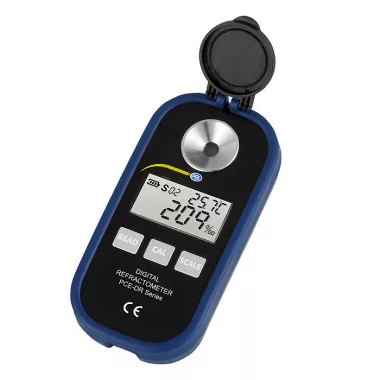
The Digital Salt Refractometer PCE-DRS 1 for salinity is a handheld instrument in waterproof design for the determination of the salinity of aqueous solutions in the measuring ranges % and ‰.
Furthermore, the digital refractometers for salinity have the measuring ranges specific gravity and refractive index. The large display of the battery-operated digital refractometer shows you not only the measured value but also the temperature of the measured medium. The main field of application of the digital refractometer is in food production, for checking brines, canned vegetables, soups, juices and many other products, but also for checking the de-icing agent preparation in winter road maintenance services.
The robust housing, made of ABS plastic, and the stainless steel sample well protect the glass prism and the electronics from mechanical damage. Calibration can be performed quickly and easily with distilled or deionized water at the touch of a button. With only three operating keys, the digital refractometer largely eliminates the possibility of operating errors and promotes intuitive instrument operation. Applications The great wonder of science is that one phenomenon makes it possible to study and determine another. The bending of light, which formed the basis for the invention of the instrument known today as the refractometer, made it possible to study, test and analyze the composition of many different products and materials. This includes determining the salt content of liquids. With the help of the salinity refractometer, it is possible to determine how much salt a liquid contains in a very short time. The portable, small devices can be used wherever the salt content needs to be checked. For example, with the help of the salinity refractometer, owners of aquariums can be sure that the salt content in the water is always at the correct level. Excessive amounts of salt can be fatal to certain species of fish. A salinity refractometer is the ideal tool here to avoid such problems.
In addition to measurement in seawater and aquariums or swimming pools, food production is an important area of application. Apart from personal taste, which of course varies from person to person, strict rules and standards apply to the salt content in various products (soups, brines, marinated vegetables, pickles, sauces, cheese, bacon, etc.). Both excessive and insufficient amounts of salt added during the production process lead to great risks, as well as to a short shelf life of the product (if the amount of salt is too low) or simply to a bad taste. Salt content is a priority issue for scientists and environmentalists around the world. The change of salinity in seas, lakes and in the soil is becoming a serious problem, as it can affect the growth and development of flora and fauna. Modern digital equipment allows for fast and accurate determination of salinity, ensuring effective and regular monitoring.
Hinweise zur Batterieentsorgung:
Da in unseren Sendungen Batterien und Akkus enthalten sein können, sind wir nach dem Batteriegesetz (BattG) verpflichtet, Sie auf Folgendes hinzuweisen:
- Batterien und Akkus dürfen nicht im Hausmüll entsorgt werden, sondern Sie sind zur Rückgabe gebrauchter Batterien und Akkus gesetzlich verpflichtet.
- Altbatterien können Schadstoffe enthalten, die bei nicht sachgemäßer Lagerung oder Entsorgung die Umwelt oder Ihre Gesundheit schädigen können. Batterien enthalten aber auch wichtige Rohstoffe wie z.B. Eisen, Zink, Mangan oder Nickel und können verwertet werden.
- Sie können die Batterien nach Gebrauch entweder an uns zurücksenden oder in unmittelbarer Nähe (z.B. im Handel oder in kommunalen Sammelstellen oder in unserem Lager) unentgeltlich zurückgeben.
- Die Abgabe in Verkaufsstellen ist dabei für Endnutzer auf die übliche Mengen sowie solche Altbatterien beschränkt, die der Vertreiber als Neubatterien in seinem Sortiment führt oder geführt hat.
- Das Zeichen mit der durchgekreuzten Mülltonne bedeutet, dass Sie Batterien und Akkus nicht im Hausmüll entsorgen dürfen
Unter diesen Zeichen finden Sie zusätzlich nachstehende Symbole mit folgender Bedeutung:

- Pb = Batterie enthält mehr als 0,004 Masseprozent Blei
- Cd = Batterie enthält mehr als 0,002 Masseprozent Cadmium
- Hg = Batterie enthält mehr als 0,0005 Masseprozent Quecksilber
Related results
pc
pce instruments
measurement technology
control technology
weighing technology
laboratory technology
development
production
calibration
pc
pce instruments
measurement technology
control technology
weighing technology
laboratory technology
development
production
calibration
pce
pce instruments
weighing technology
platform scales
shipping scales
pallet scales
inventory scales
platform scales
industrial scales
multifunctional scales
compact scales
weighing platform
pce
pce instruments
measurement technology
machines
systems
vibration measurement
vibration measuring device
vibration measuring device
accelerometer
stethoscope
data logger
Complete catalogs
The offer is aimed exclusively at business customers, companies, public institutions, tradesmen and freelancers. All prices in catalogues are exclusive of VAT, shipping costs and surcharges if applicable.
The manufacturer is exclusively responsible for the content, price and article details of the products and offers presented in the catalogues. Subject to technical and optical changes by the manufacturer and errors excepted.
The manufacturer is exclusively responsible for the content, price and article details of the products and offers presented in the catalogues. Subject to technical and optical changes by the manufacturer and errors excepted.


Product suggestions
-62%


Twist drill set DIN 338 type VA HSSE Co 5 ground in bench stand
215223
€239.87
€635.00 MSRP
-64%

21-piece set of machine taps HSS Co 5
245054
€136.46
€374.16 MSRP
-27%


ASSEMBLY WORKBENCH FMW 150/5/T WITHOUT CABLE ON 1 DOOR, 1 SHELF, 5 DRAWERS
00.05.9071
€2,317.94
€3,176.01 MSRP
-38%


PowerGRIP plier wrenches, 300 mm
87180315
€52.65
€84.83 MSRP
-29%


Laserboy II red - individually packed
649015
€194.16
€273.66 MSRP
-29%

autoMAGIC set: basic device with receiver, wall bracket, target plate and 4 batteries, in case
654KLP5SP-SET
€470.63
€666.55 MSRP
-41%


Stechbeitelsatz mit Weißbuchenheft 10-20-26mm mit Japan-Handsäge
1195000
€99.24
€167.82 MSRP


Werkstattwagen by Hazet
05009000
€755.46


Parallel pin punches PRO, Set 3 - 10mm
0718 9560
€88.19
-16%


TB 13 Plus MK II bench drill with adjustable drill table
212503
€2,963.36
€3,531.22 MSRP
-16%

TB 10 Eco plus bench drilling machines
217200
€1,554.66
-40%


13221 WT/TS Tool Trolley With Tcs-Inlay And Hand Tools
98814915
€3,089.32
€5,188.32 MSRP
PCE Salt Refractometer PCE-DRS 1
pc
pce instruments
measurement technology
control technology
weighing technology
laboratory technology
development
production
calibration
pc
pce instruments
measurement technology
control technology
weighing technology
laboratory technology
development
production
calibration
pce
pce instruments
weighing technology
platform scales
shipping scales
pallet scales
inventory scales
platform scales
industrial scales
multifunctional scales
compact scales
weighing platform
pce
pce instruments
measurement technology
machines
systems
vibration measurement
vibration measuring device
vibration measuring device
accelerometer
stethoscope
data logger
The Digital Salt Refractometer PCE-DRS 1 for salinity is a handheld instrument in waterproof design for the determination of the salinity of aqueous solutions in the measuring ranges % and ‰.
Furthermore, the digital refractometers for salinity have the measuring ranges specific gravity and refractive index. The large display of the battery-operated digital refractometer shows you not only the measured value but also the temperature of the measured medium. The main field of application of the digital refractometer is in food production, for checking brines, canned vegetables, soups, juices and many other products, but also for checking the de-icing agent preparation in winter road maintenance services.
The robust housing, made of ABS plastic, and the stainless steel sample well protect the glass prism and the electronics from mechanical damage. Calibration can be performed quickly and easily with distilled or deionized water at the touch of a button. With only three operating keys, the digital refractometer largely eliminates the possibility of operating errors and promotes intuitive instrument operation. Applications The great wonder of science is that one phenomenon makes it possible to study and determine another. The bending of light, which formed the basis for the invention of the instrument known today as the refractometer, made it possible to study, test and analyze the composition of many different products and materials. This includes determining the salt content of liquids. With the help of the salinity refractometer, it is possible to determine how much salt a liquid contains in a very short time. The portable, small devices can be used wherever the salt content needs to be checked. For example, with the help of the salinity refractometer, owners of aquariums can be sure that the salt content in the water is always at the correct level. Excessive amounts of salt can be fatal to certain species of fish. A salinity refractometer is the ideal tool here to avoid such problems.
In addition to measurement in seawater and aquariums or swimming pools, food production is an important area of application. Apart from personal taste, which of course varies from person to person, strict rules and standards apply to the salt content in various products (soups, brines, marinated vegetables, pickles, sauces, cheese, bacon, etc.). Both excessive and insufficient amounts of salt added during the production process lead to great risks, as well as to a short shelf life of the product (if the amount of salt is too low) or simply to a bad taste. Salt content is a priority issue for scientists and environmentalists around the world. The change of salinity in seas, lakes and in the soil is becoming a serious problem, as it can affect the growth and development of flora and fauna. Modern digital equipment allows for fast and accurate determination of salinity, ensuring effective and regular monitoring. en ["de","en","it","nl","nl","fr","es","pl","pt","cs","da","sv"] 256.8 United Kingdom GB